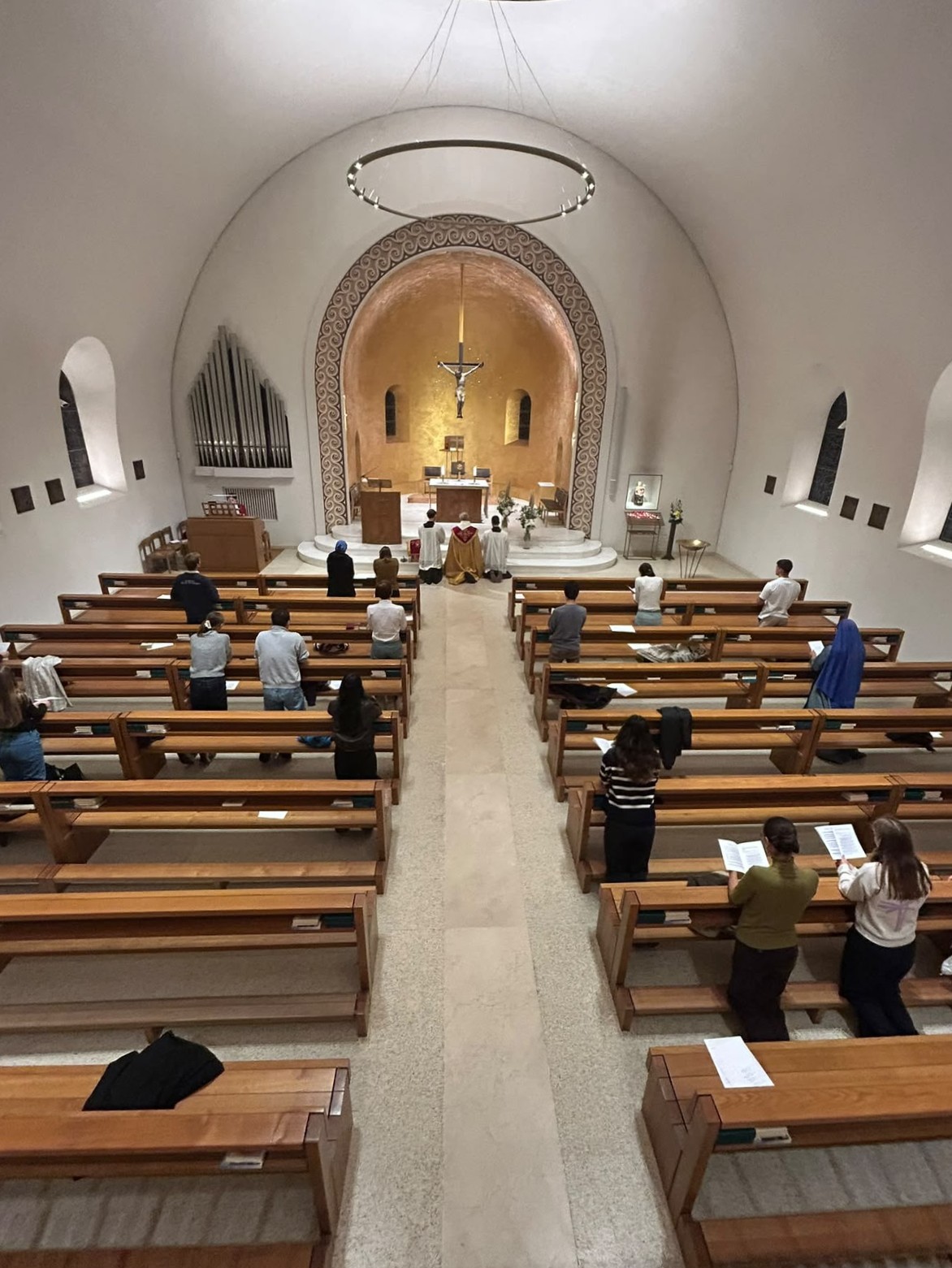
Every Thursday · from 8 to 9 pm
Going to confession
A priest is there throughout the adoration
Throughout the adoration, a priest is there to hear confessions. Just go up to him, even if it has been a long time.
When
Thursday
Time
8 – 9 pm
Where
Lausanne
Step by step
How to go to confession
At “……”, name your patron saint, then the time since your last confession.
- 1The penitentBless me, Father, for I have sinned.
- 2The priestIn the name of the Father, and of the Son, and of the Holy Spirit.
Penitent: Amen. - 3The penitentI confess to almighty God, to blessed Mary ever Virgin, to Saint …… and to all the saints, and to you, Father, that I have sinned greatly, in thought, word and deed: through my fault…
My last confession was …… ago (so many weeks, months…). - 4Confessing one’s sinsConfession of sins, in the light of a conscience examined in the presence of God.
For these sins and all the sins of my past life, I ask pardon of God, and of you, Father, penance and absolution.
Therefore I beg blessed Mary ever Virgin, Saint …… and all the saints, and you, Father, to pray for me to the Lord our God. - 5The priestWords of encouragement, and a penance is given (satisfaction).
- 6The penitent · Act of contritionMy God, I am deeply sorry for having offended you, because you are infinitely good, infinitely lovable, and sin displeases you. With the help of your holy grace, I firmly resolve to offend you no more and to do penance.
- 7The priest · AbsolutionMay God our Father show you his mercy…
- 8The priestGo in peace!
Penitent: Thanks be to God. - AfterGiving thanksCarry out the penance as soon as possible, thank God for the forgiveness received and renew your resolution.
Preparing
Examination of conscience
Before you begin, say this prayer to God: “My God, I beg you, through the intercession of the Virgin Mary, to grant me the grace to know well all the sins of which I am guilty. Then let me confess them with sincere sorrow for having committed them and a firm will to avoid them in future, and so obtain their forgiveness from your infinite mercy. Amen.”
1st commandment: “You shall worship God alone and love him above all things.”
Neglecting prayer (especially in the morning and evening) and the sacraments of Penance and the Eucharist… Sacrilegious communions or confessions… Lack of respect for the sacraments… Breaking the fast before communion (at least one hour)… Deliberate doubts against the faith… Putting one’s faith in danger through harmful reading or company… Human respect… Lack of trust in God, or presumptuous trust in one’s own strength… Indifference towards God… Superstitious practices, spiritualism… Neglecting one’s Christian formation…
2nd commandment: “You shall not take the name of God in vain.”
Using God’s name needlessly… Blasphemy, curses, swearing… False or needless oaths… Disrespect towards persons and things consecrated to God… Failing to keep vows one has made…
3rd commandment: “You shall keep holy the Lord’s day.”
Missing Sunday Mass or holy days of obligation deliberately or without reason… Arriving late on purpose, or being distracted during Mass… Doing or ordering unnecessary work… Pastimes contrary to keeping Sunday holy…
4th commandment: “Honour your father and your mother.”
Lack of love, affection, respect, obedience or help towards one’s parents during their lives, and of prayer for them after their death… Hurt caused… Family quarrels over money… Lack of deference towards superiors…
5th commandment: “You shall not kill.”
Attacks on life, one’s own or another’s, from conception to natural death… Wishing death or misfortune on someone… Revenge, violence, harm to health, drugs, alcohol… Insults, contempt, hatred, refusing to forgive… Indifference to the suffering of others… Scandal through bad example or silent approval…
6th and 9th commandments: “You shall not commit impurity” and “You shall not consent to impure desires.”
Entertaining impure thoughts or desires… Immoral reading, shows or content (television, internet…)… Sinful familiarity… Actions contrary to chastity, alone or with others… Provocative clothing or behaviour…
7th and 10th commandments: “You shall not steal” and “You shall not unjustly desire the goods of others.”
Theft, keeping things found or borrowed… Unjust damage to the property of others… Fraud, cheating at work or in studies… Neglecting to pay one’s debts… Damage to public property… Waste… Careless work…
8th commandment: “You shall not lie.”
Lies… Gossip or slander, spoken or approved… False accusations… Rash judgements… Breaking a confidence… Hypocrisy… Cheating… Broken promises…
The precepts of the Church
You shall keep holy the days of obligation. You shall attend Mass on Sundays and holy days of obligation. You shall confess your sins at least once a year. You shall receive Holy Communion every year during the Easter season. You shall fast on the days set by the Church (Ash Wednesday and Good Friday). You shall abstain from meat on the days set by the Church.
The capital sins
Pride: disordered self-love, self-satisfaction, selfishness, vanity, touchiness… Avarice: refusing to share, or to help those in need… Lust: vices contrary to the 6th and 9th commandments. Envy: jealousy of the happiness, possessions or successes of others… Gluttony: excess in eating and drinking… Anger: outbursts, grudges, resentment, sulking… Sloth: in getting up, in work, in prayer; habitually avoiding effort…
The duties of one’s state in life
An often forgotten area: one’s personal duties as a Christian, duties towards one’s neighbour, family duties, duties as a student or at work, civic duties. The full examination is in the prayer booklet, pp. 26 to 30 (in French).
Understanding
The sacrament of Reconciliation
Why did Christ institute the sacraments of Penance and the Anointing of the Sick?
Christ, the physician of soul and body, instituted them because the new life that he gave us in the sacraments of Christian initiation can be weakened and even lost because of sin. Therefore Christ willed that his Church should continue his work of healing and salvation by means of these two sacraments of healing.
Why is there a sacrament of Reconciliation after Baptism?
Since the new life of grace received in Baptism does not abolish the weakness of human nature nor the inclination to sin, Christ instituted this sacrament for the conversion of the baptised who have separated themselves from him by sin.
What are the essential elements of the sacrament of Reconciliation?
There are two: the acts of the penitent who comes to conversion through the action of the Holy Spirit, and the absolution of the priest who, in the name of Christ, grants forgiveness and determines the ways of making satisfaction.
What are the acts of the penitent?
They are: 1. a careful examination of conscience; 2. contrition, which is perfect when it is motivated by love of God, and imperfect when it rests on other motives and includes the resolution to sin no more; 3. confession, which consists in telling one’s sins to the priest; 4. satisfaction, that is, carrying out certain acts of penance which the confessor imposes on the penitent to repair the harm caused by sin.
Which sins must be confessed?
All grave sins not yet confessed, which one remembers after a careful examination of conscience, must be confessed. The confession of grave sins is the only ordinary means of obtaining forgiveness.
Why are venial sins also the matter of sacramental confession?
Although the confession of venial sins is not strictly necessary, the Church strongly recommends it, because it helps to form a right conscience and to fight against evil inclinations, so as to let oneself be healed by Christ and to grow in the life of the Spirit.
What are the effects of this sacrament?
Reconciliation with God, and therefore the forgiveness of sins; reconciliation with the Church; recovery of the state of grace if it had been lost; remission of the eternal punishment merited by mortal sins, and of the temporal punishment which results from sin, at least in part; peace and serenity of conscience and spiritual consolation; an increase of spiritual strength for the Christian struggle.
Going further
III
Prayer intentions
Entrust your intentions: they are brought before the Blessed Sacrament on Thursday.

